|
STORY: BEYOND THE CLOUDS
The film begins with a shot of an airplane wing above the clouds, then shots of a man looking out through a window. He addresses us in English, sometimes on camera, sometimes on the soundtrack. He is a film director, the "I" of the Tiber book, thus Antonioni. John Malkovich plays this role, giving the man depth and intelligence. He is traveling through France and Italy in search of visual inspiration for his next work. Glimpses of strangers provide fodder for his imagination, which conjures up several stories about meetings between lovers. The first three stories serve up the familiar elements of this director's universe: Fog and mist obfuscate characters' clear vision on their surroundings; time among the upper classes is spent pursuing beauty and avoiding despair; and men and women fall in love with each others' luxurious façades. But wealth and position prove illusory comforts.
The first vignette is about Carmen (Ines Sastre) and Silvano (Kim Rossi-Stuart), both astonishingly beautiful, who engage in a brief encounter so electrifying that consummation threatens to diminish it: Spoken in Italian, the story takes place in Ferrara, Italy, the director's hometown, and begins with a long perspective of a cloister-like walk with two modern young people (the present embracing the past). The two meet by chance, then spend the night separately in different hotel rooms. Carmen expects Silvano to come to her hotel room, but he, waiting for the right moment, falls asleep. Three years later, after they run into each other at the cinema, he can barely touch her naked body: it's too perfect to caress, to experience, so he leaves her. He wants Dante's Paradise. Sweet, financially privileged Silvano cannot offer any true sacrifice of himself, and the closest he can come to love is the realization that he cannot make human contact. Physical beauty, too, is a deception.
In the second story the narrator meets a young shopgirl (Sophie Marceau) in off-season Portofino. She tells him in their first conversation (done in English) that she murdered her father, stabbed him twelve times. Since she was acquitted in her trial, the killing was apparently justified. Her declaration doesn't discourage the man. They go to bed. Then he leaves, having said that he thinks twelve stabs were "domestic," fewer would have been murder. The woman's confession and its sexual effect on him have a certain pungency, but it quickly evaporates.
Between the second and third vignettes, apparently because Antonioni
wanted a touch of lightness and a whiff of nostalgia, there's a brief country scene.
Marcello Mastroianni is a painter on a hill doing a landscape that Cezanne once painted,
except that now there's a factory in the vista. Along comes Jeanne Moreau, who (in French)
questions the worth of copying. He says that if he can at least repeat one gesture that
Cezanne made, he will be gratified.
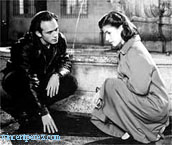
Set in Aix-en-Provence, and also done in French, the last story is Gallic in a different way - a sort of Maupassant twist. A handsome, leather-jacketed young man named Niccolo (Vincent Perez) gets romantically caught up with a pious young woman (Irene Jacob) as she dashes off to church. He's insipid but sincere; she's pure but remote.
While he accompanies her home, the two potential lovers refuse to gaze distantly, but look upwards at the rain falling as the water drops like a heavenly fountain. She tells him that she is in love. He asks what would happen if he fell in love with her. She says, "It would be like lighting a candle in a room full of light." When they part at her door, she tells him that the next day she will enter a convent. Her remarks about the clarity she has gained by perceiving worldly desires as illusions come the closest of any character to matching the closing words of Malkovich, who muses that the project of life is to arrive at "the true image of that absolute, mysterious reality, which no one will ever see."
|